Dr Mamphela Ramphele wrote an interesting piece in the Sunday Times in April 2017 which set me off on an in-depth investigation of Cheikh Anta Diop and African history. My first piece on Diop is in the form of a letter to the editor of the Sunday Times, which I later felt was too controversial to be published in the current political environment.
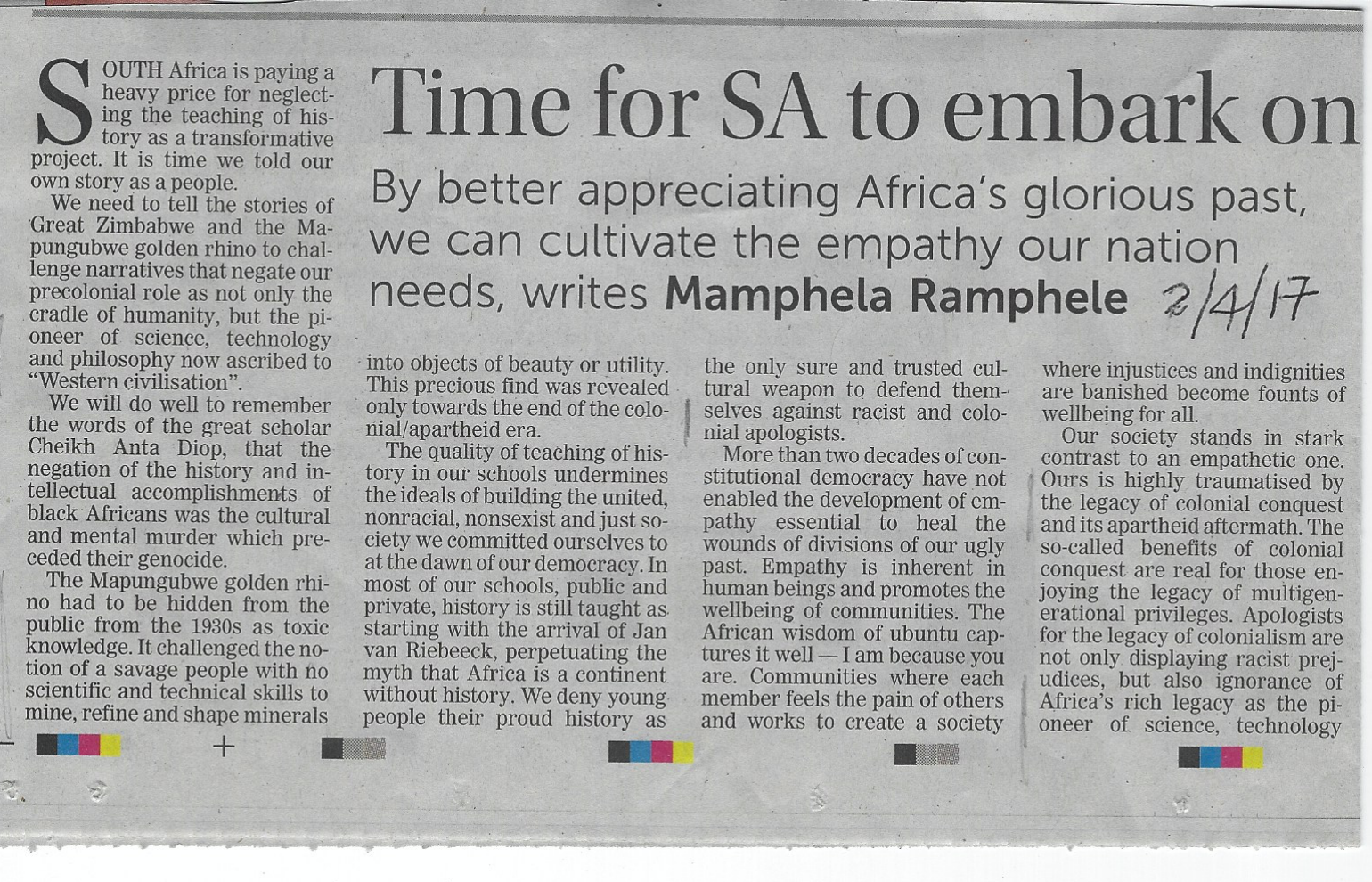

I read Mamphela Ramphele’s call to re-examine the pre-colonial history of Africa (Time for SA to embark on the pilgrimage of healing, 2 April 2017) with interest and a great deal of skepticism. In particular, her claim that “our people” (presumably black Africans) were the pioneers of science, technology and philosophy is ludicrous.
By way of supporting this claim, she recommends reading Cheikh Anta Diop’s book Civilisation or Barbarism for details of Africa’s proud contribution to global knowledge.
I have read Diop’s book with some care and a more turgid, meandering read would be hard to find, certainly not one to be recommended for the common man. I remain unconvinced of his thesis that the Egyptians were black since I find his logic, such as it is, difficult to follow. However, his demonstration of the sophistication of Egyptian mathematics and science is laughable, containing as it does not a few inaccuracies and downright falsehoods. Egyptian mathematics is more accurately referred to as “applied arithmetic” and lacks the axiomatic method as introduced by Euclid and other Greeks to turn it into mathematics as we know it today.
Diop was an Afrocentrist whose stated motive was to unite the black African people by revealing their hitherto “hidden history”. Some of his methods leave a lot to be desired: for example, extracting melanin from the skins of Egyptian mummies to “prove” that they were black. Such mummies could well have been Nubians who were known to have integrated into Egyptian society, and who were obviously black.
It seems to me that a great deal of research and exploration has been done since Diop wrote in the 1970’s, and some of his methods and conclusions may well not stand the test of time. For example, it seems that the Nubians (or Kush) and the Egyptians were separate nations (as determined from study of their languages) that spent considerable time invading each other, with various successes on both sides. The point is that the Nubians were not Egyptians although a proportion of Nubians did integrate into Egyptian society and the 25th Dynasty was in fact a Nubian one. Nevertheless, their contribution to Egyptian culture remains uncertain.
However, more interestingly, the Nubian nation does not appear to have had any direct relationship to the Bantu (i.e., the Niger-Congo language group) who migrated southwards from west-central Africa and form the basis of today’s southern African black population. Hence, even if the Nubians had contributed to Egyptian intellectual progress, it does not necessarily reflect on the Bantu nations, who should perhaps stand on their own recognisances.
Thus, in what way did Great Zimbabwe and Mapungubwe contributed to “science, technology and philosophy”, as Ramphele would have us believe? Neither left any written record and both were simply abandoned by their people well before colonialism arrived, leaving nothing but stone structures and crude gold craftwork behind.
There is a brief but excellent article here in National Geographic on this topic. (The article may since have been archived, but search for "black pharoahs")
- If the Egyptians were black Africans where did they come from given that the (black) Nubians were their acknowledged southern neighbours?
- It is acknowledged that the 25th Dynasty was a Nubian one, and the 23rd a loose grouping of Lybian kings. If Egypt was a black African society why did historians need to state that one particular dynasty was Nubian?
- It is acknowledged that Nubians integrated into Egyptian society. Why was it necessary to state this if the Egyptians were already a black society?
- If the Egyptians were the pioneers of science, technology and philosophy why did they not use this knowledge to advance their own civilization, in the same way that the later Greeks and Romans did? In fact, both the Greeks and Romans subsequently conquered Egypt: Alexander the Great in 332 BCE and Octavian in 30 BCE.
- Why was Dr Ramphele content to support the work of Diop when there was already controversy about his work? For example, he never published his work in peer-reviewed journals. Presumably she considered the opposition to his work as coming from (racist) historical revisionists.
May 2017