Life on a Diamond Barge
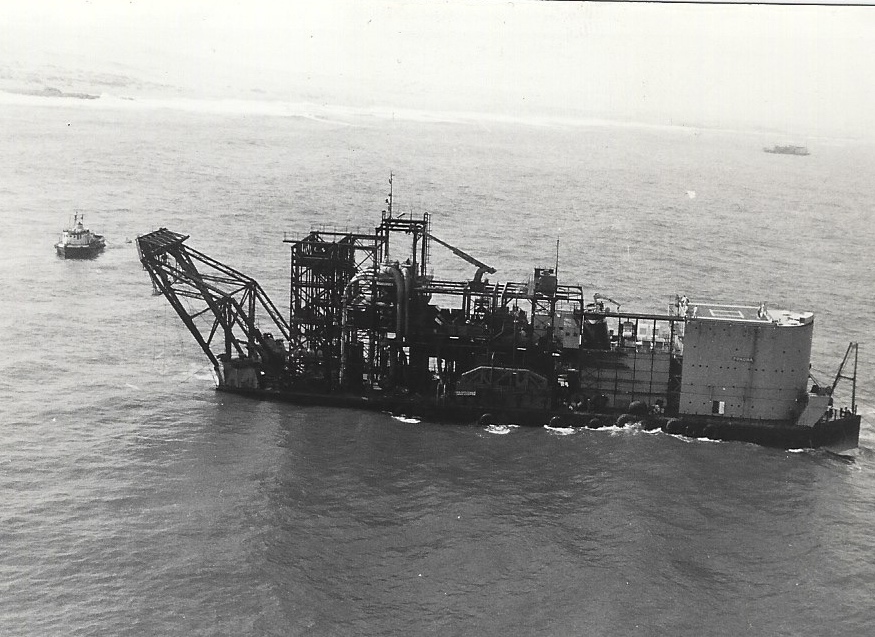
I went to the diamond barges straight out of matric in 1966 because I needed to earn as much cash as possible to get me through at least my first year of university; and I didn't want to work in an office. I was seventeen years old and in hindsight, way out of my depth. This was a dangerous and desolate job.
There were two diamond barges in operation at the time, operated by Marine Diamond Corporation (MDC). The barges were stationed about 2km or so off the coast, about half-way between Luderitz and Alexander Bay/Oranjemund. The general principle of diamond mining was to lower a large pipe onto the ocean floor and suck up the top layer of gravel. This was then gravity-fed down through the plant which filtered out all the rocks and gravel until only a pan full of fine sand and diamonds was left. The plant is that massive structure shown in the middle picture below.
MDC operated 365/7/24 which required three shifts of personnel: you started with 9 days on day shift, followed by nine days on night shift and then 9 days leave back home. This meant flying to Namibia roughly once a month, in a clapped out propellor-driven Skymaster. We landed at Luderitz and then took a small ship down to the diamond field, a trip of about 8 hours. We spent the trip in the ship's saloon, mostly on the floor, and in my case hanging over the side puking into the roaring wind and spray. It was a nightmare!
But worse was to come. Upon arrival at the barge we had to jump from the side of the ship into a dinghy in massive swells, in the dark, and be ferried to the side of the barge where we leapt from the dinghy onto a steel ladder and heaved our way on board. Exhausted and nauseous, I probably had less than three hours sleep before being woken up for my first 12-hour shift. I didn't know what had hit me!
I was appointed as a learner plant operator on the old Triple-One barge (actually Barge III). This entailed wandering up and down the plant for twelve hours a day (7am to 7pm) checking that everything was running smoothly. It was extremely noisy and dirty and a terrible place to work, especially at night or in winter, because one was continually exposed to the elements!
Life on the Triple-One was pretty awful. It had no showers so that one had to wash in a hand basin in cold water, this after 12 hours of dirty work. The toilets had no doors which really freaked me at first. And being the youngest guy onboard (by far) working with some particularly rough men meant I was often teased and bullied: for example, they wanted to cut my hair. I shared a tiny cabin with five other crew, in bunks.
The only good thing was the food. They really did feed us well, with typed-up menus at every meal. After every shift there was a movie and liquor was also sold. I never once attended a movie because after a 12-hour shift I was so exhausted I simply fell into bed. After the 18-day trip you had to repeat the horrendous journey back home.
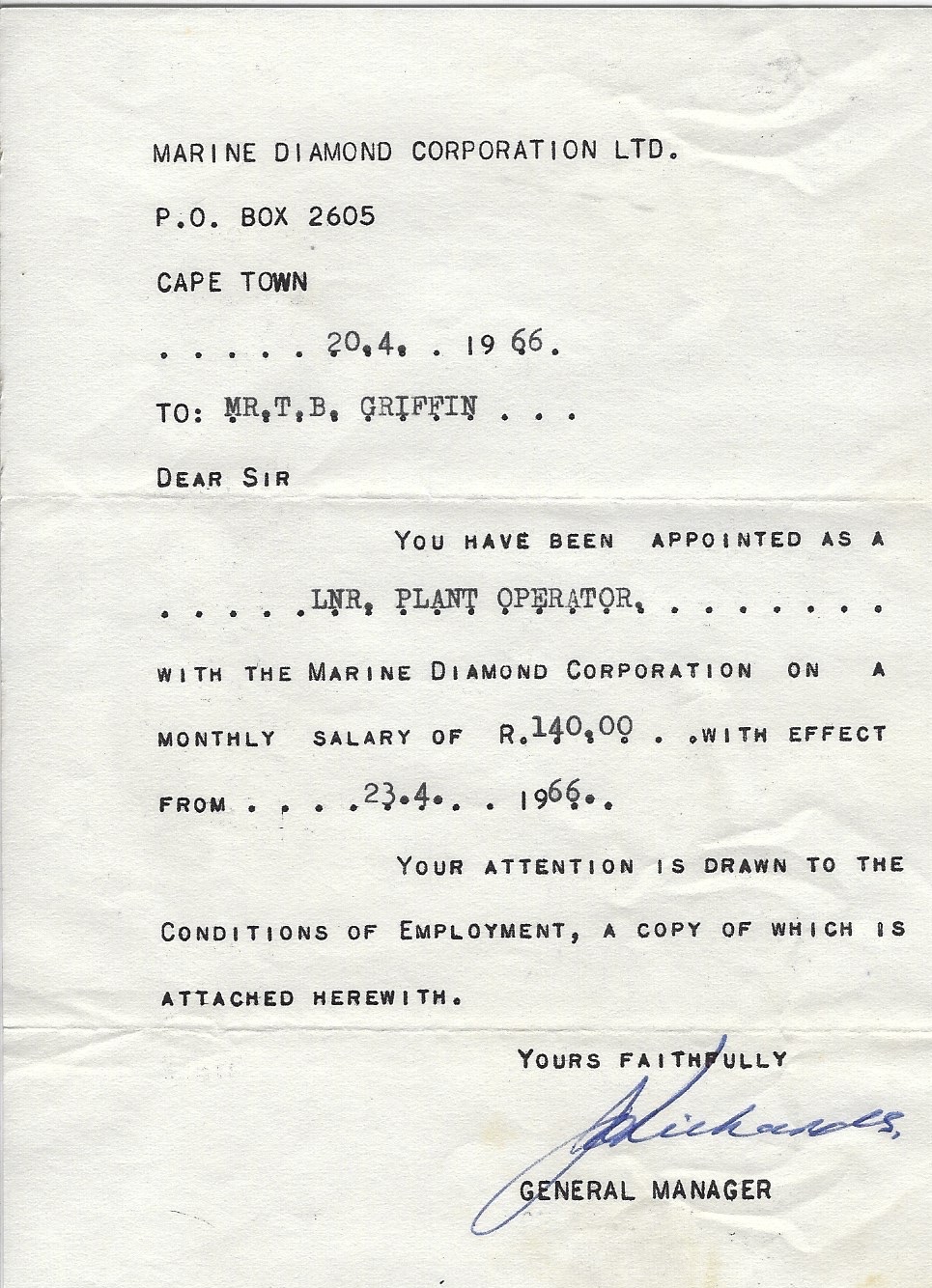
My initial Appointment

The Pomona plant, close-up
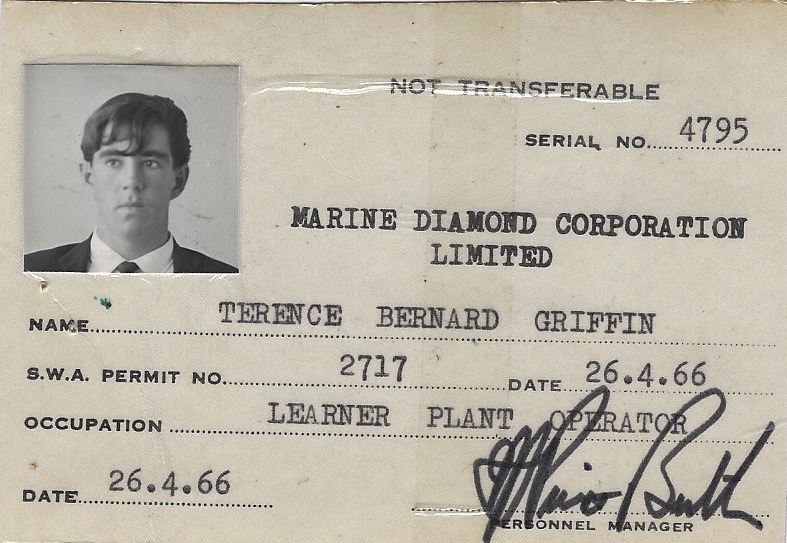
My initial ID
After four months I was promoted to Assistant Plant Operator at R160/m. For a eighteen-year-old lad this was a considerable sum, especially when you consider that for two thirds of my month I had absolutely no expenses. Then one fateful day around 10am I was working down in the hold where the huge cyclone pumps were and I inadvertently placed my foot (in a rubber boot) on the pumps V-Belt, causing my foot to be dragged around the pulley and hurled out. My foot was thrown out with such force that it snapped my leg at the knee, causing me to nearly kick myself in the face. I felt absolutely nothing! Since I was alone I had to drag myself across the hold to the steel stairway and haul myself up 25 stairs. Once at the top I had to stand and wait for someone to walk by and help me. Eventually my superintendant came by and I told him what had happened. He carried me to his cabin and summoned the doctor, who unfortunately was on another barge and needed to be shipped across. Meantime, I called for a cigarette and lay back and waited. I still felt no pain at all.
The doctor arrived, cut away my overalls and had a peek. The knee was completely split across the back and the knee joint dislocated. Fortunately no veins or arteries had been damaged and there was little blood. He gave me a morphine shot and another smoke and called up the helicopter, which was a second miracle because the helicopter service had only been instituted six weeks previously. I flew by helicopter to Oranjemund and from there to Cape Town in a small plane, arriving at the Mowbray Cottage Hospital around 7pm. I went into surgery and woke up three days later with my leg suspended in traction from the ceiling; and a catheter for good measure.
And there I lay for eight weeks. I was placed in a large ward with windows all around, overlooking the garden. I had my guitar and, believe it or not, I could smoke, although I gave up soon enough. I used to listen to all the hit parades although I can't for the life of me remember how: portable radio? Hospital was followed by another six weeks on crutches. A couple of months later I was walking and surfing again. To this day I have never had a day's trouble or pain from my leg.
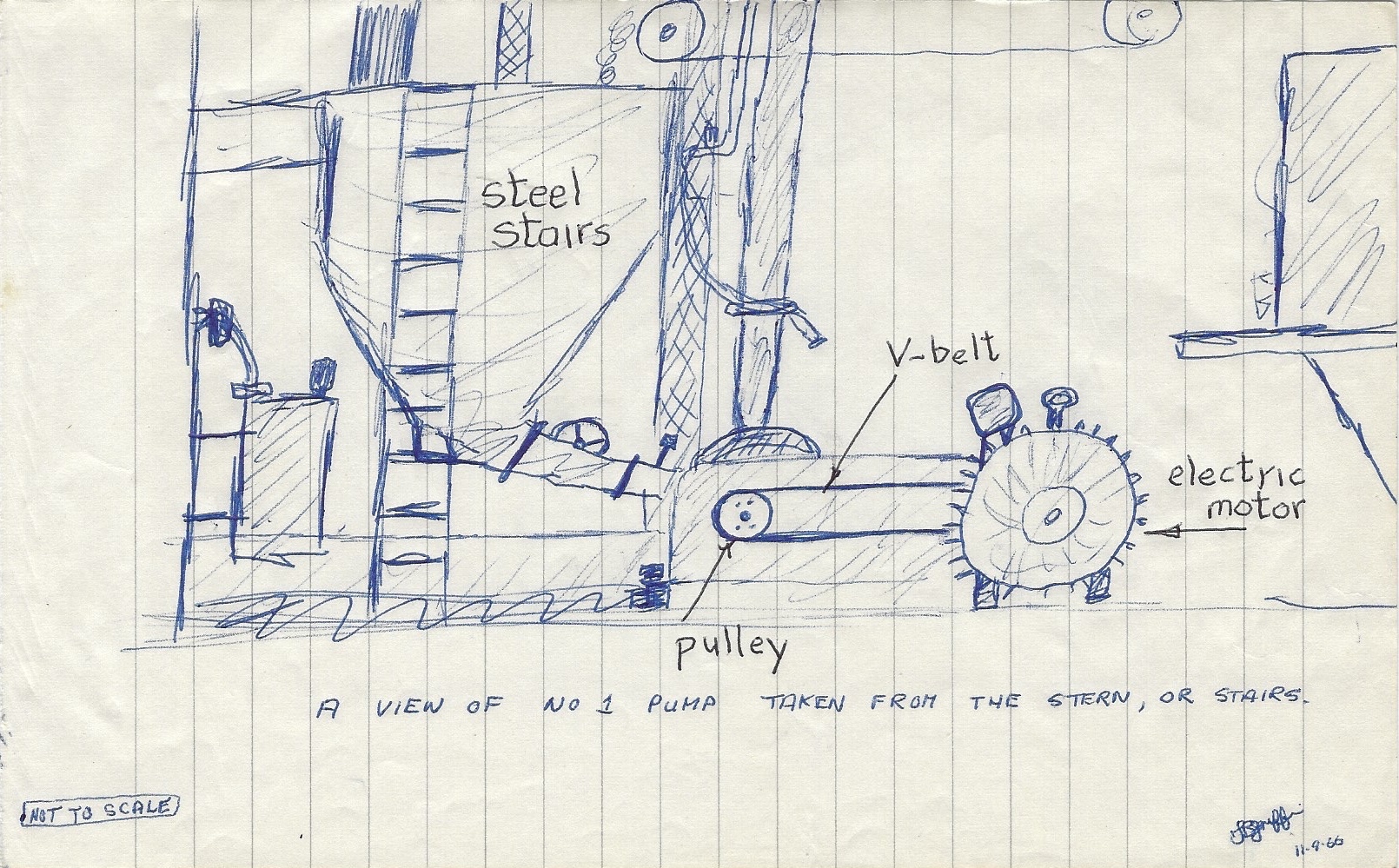
The Cyclone Pump in the Hold (sketch from 1966)
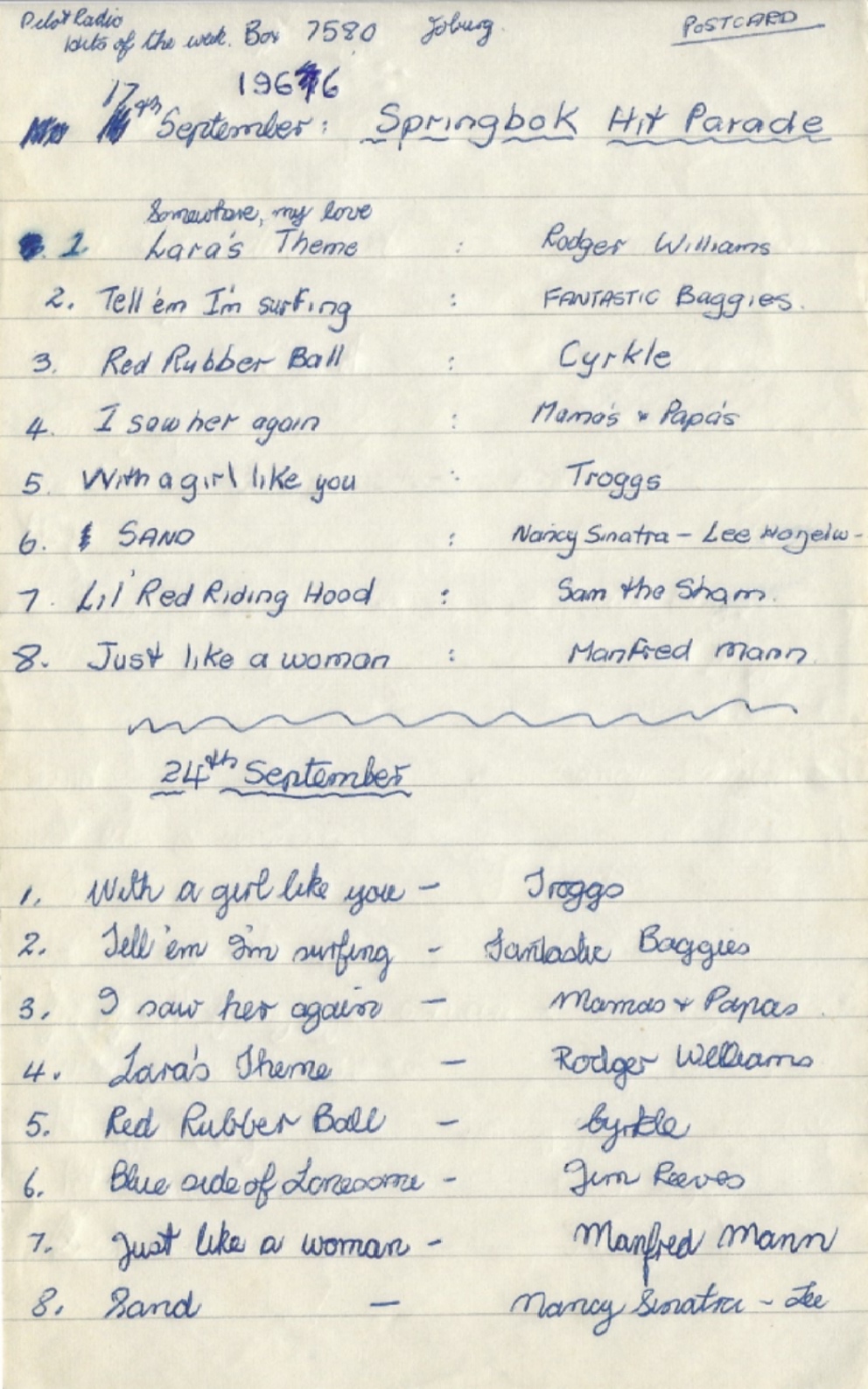
Springbok Hit Parade, September 1966!
Marine Diamonds were clearly negligent in that there was no safety barrier around the V-Belt, and we should have sued them blind. They clearly knew they were at fault: they paid my full salary until the end of the year and offered me a bursary to study mechanical engineering at UCT. Silly me declined (I didn't want to be a mechnical engineer!) but I suggested I go back as a surveyor on the landparty. Surveyors were required to sit in a shack on the shore opposite the barges and plot exactly where they were every hour in order to document where the most diamonds were coming from. So in March 1967 off I went again.
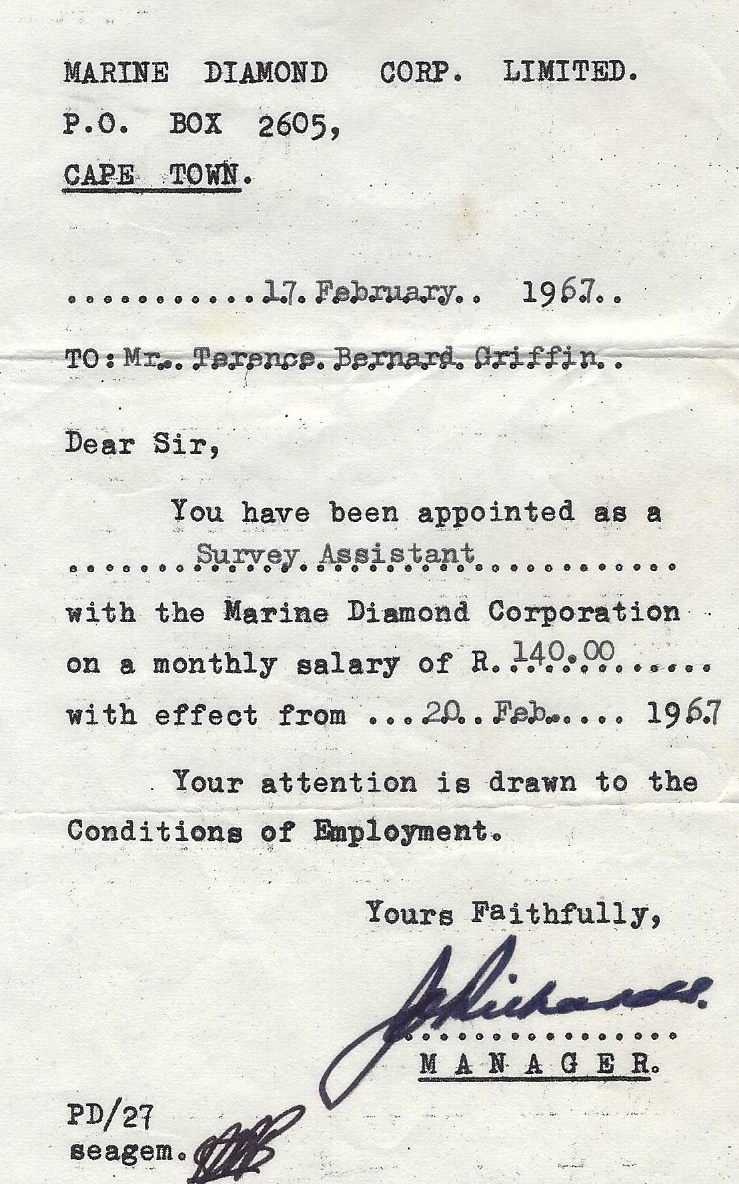
My surveyor Appointment

The Landparty Base
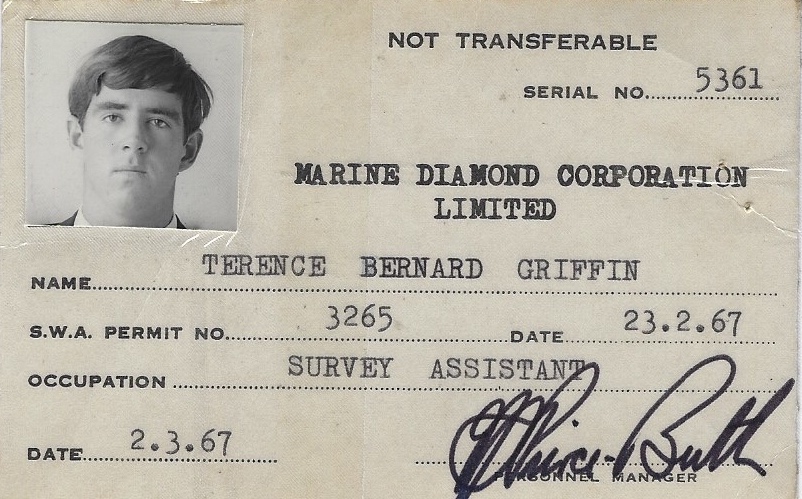
My surveyor ID
This was a cool gig! There were about eight of us living in a ramshackle base high on a hill overlooking the sea and the barges. We worked the same schedule as the barge people, and every day I would drive a Land Rover off to the nearest survey hut, maybe 5km away, and spend the next 12 hours in blissful solitude, taking one reading per hour of my alloted barge. When on night shift I had the whole day to explore the Namib Desert! The coastal waters were knee-deep in crayfish and the sands were literally littered with semi-precious stones such as tiger's eyes and agates.
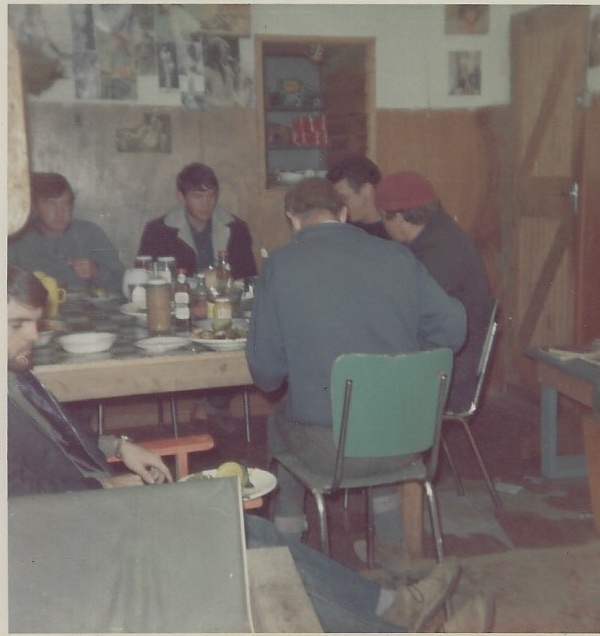
Dinner at Landparty
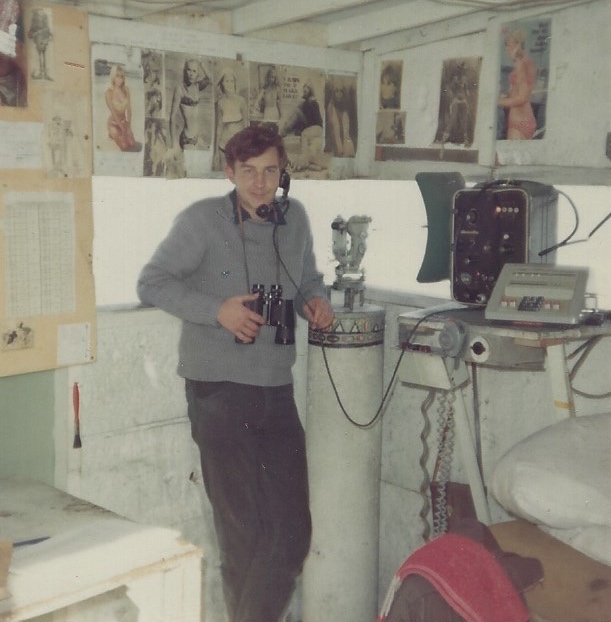
A Survey Shack: note the pinups!

Landparty Garage and Vehicles
I had an interesting experience while I was there. On one trip I was recalled early to return to CT. I drove to Oranjemund, boarded the plane (a DC 3 Dakota), and minutes before take off was ordered off and back to landparty base. I jumped in the the old Landie and headed off on the gravel road through the Namib back to base, about 80km away. About an hour later the Landie conked out. It was now late afternoon and I had no idea where I was and worse, nobody knew I was stuck in the middle of the desert, with no food or water. I set off on foot towards what looked like a hill from which I hoped I could reconoitre the landscape. No such luck, just endless hills of sand and absolute silence. I returned to the Landie and settled in for the night.
I managed to sleep although I was woken at times by what I assumed were animals sniffing at the doors. As the dawn broke I set off again, aiming to walk back to camp. After a few kilometers I saw another Land Rover approaching and lo and behold my boss hoved into view, on his way to Oranjemund. He soon discovered the problem (I can't remember what it was) and with a cheery wave I set off for base and he onward to Oranjemund.
The Pamona was a spanking new barge commissioned in mid-1967, and having both sea and survey experience I voluteered to join its crew. This was a whole different experience from my previous ordeal on the Triple-One. The accomodation was spacious, with showers, a recreation area and dining room serving fine meals (see below). And no more gruelling boat trips from Luderitz; now we had a short helicopter ride to a new landing strip opposite the barges for the trip to and from home.
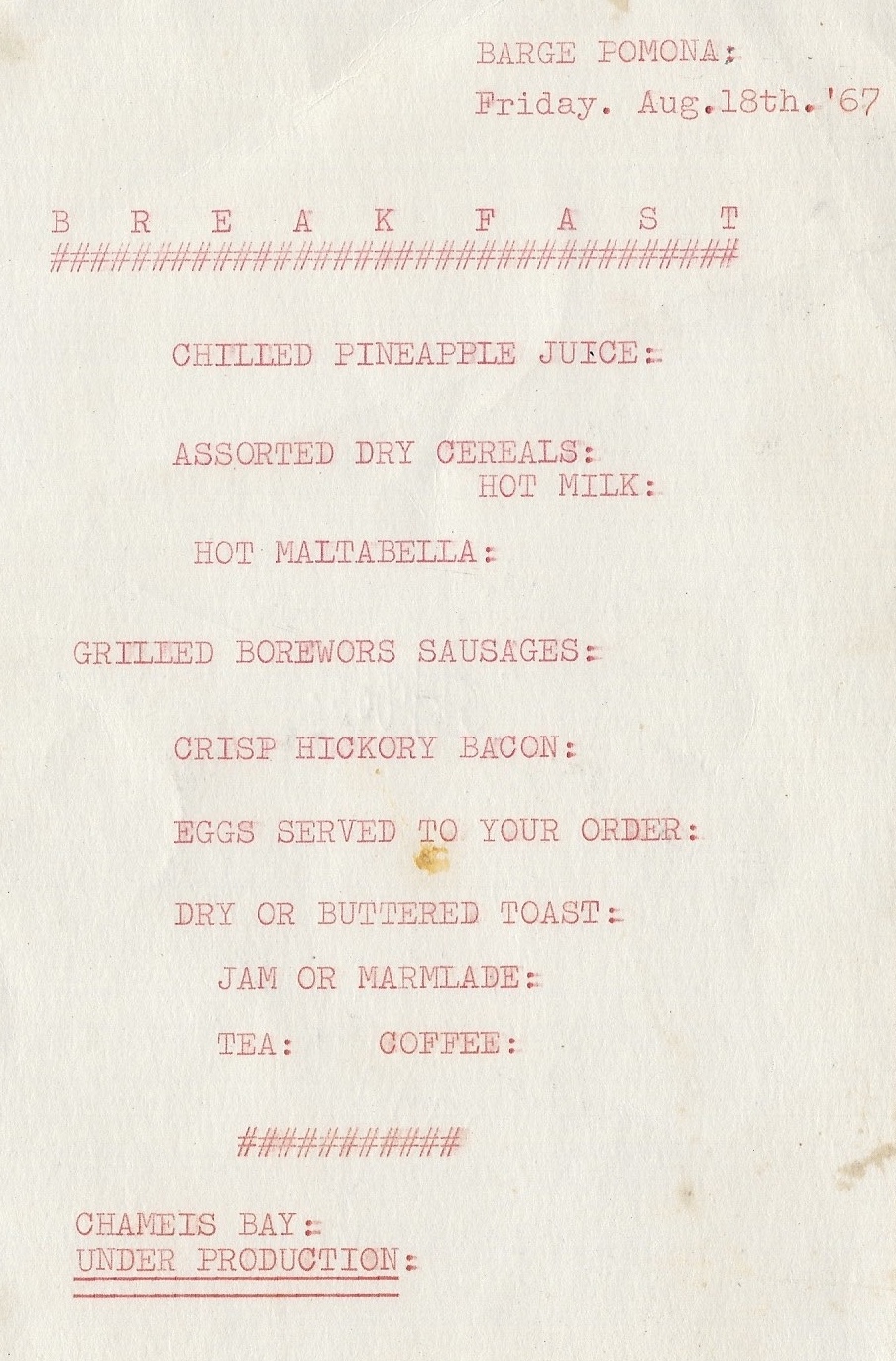
Breakfast Menu
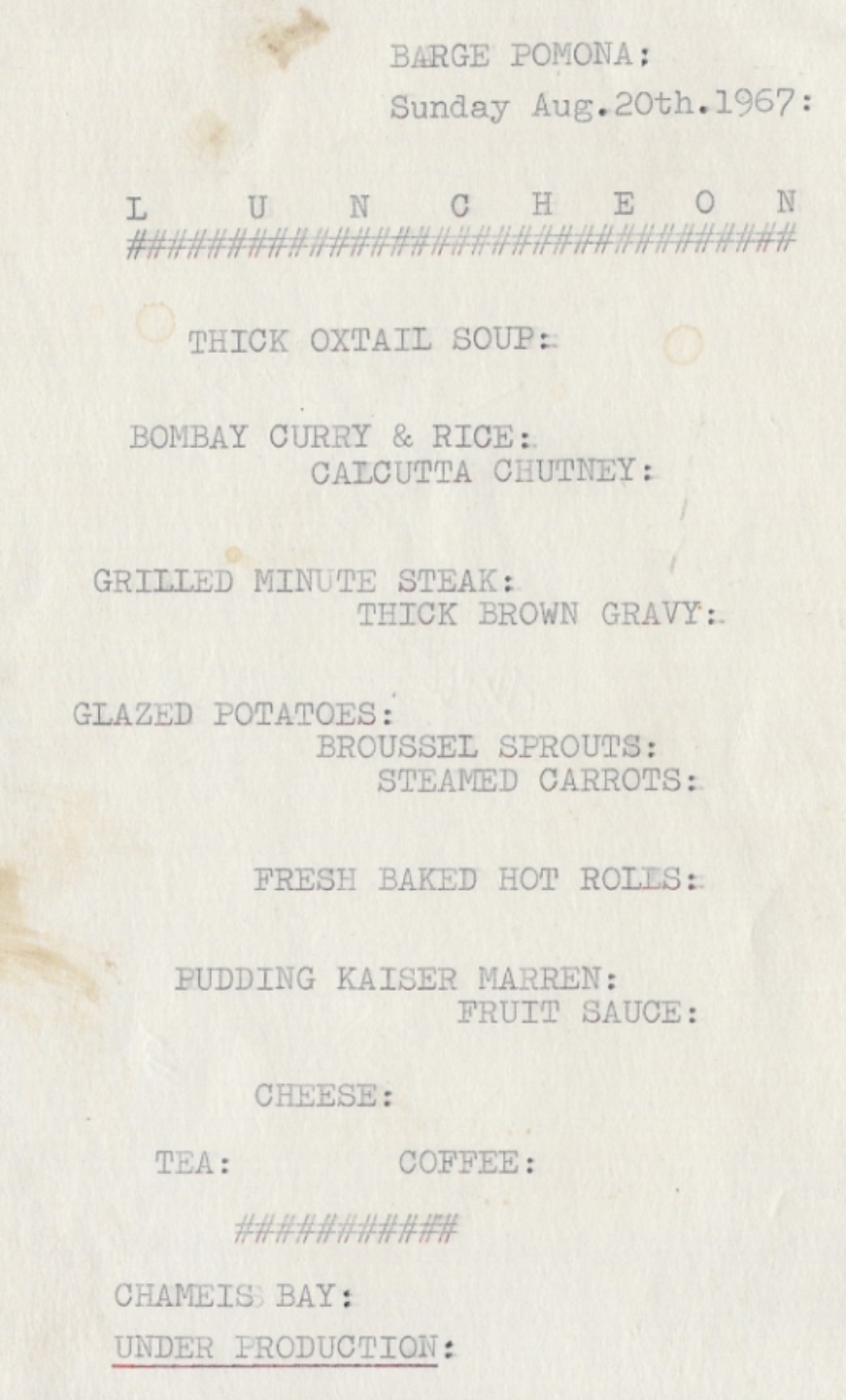
Luncheon Menu
Being a surveyor I worked from the comfort of the bridge, a far cry from the filthy plant of the Triple-One. In fact I had very little to do since the surveyor in the survey shack onshore did most of the heavy lifting. So I whiled away the uneventful year saving my money and spending my home leave surfing. I resigned in early December 1967 and prepared to go to university.