My Working Career
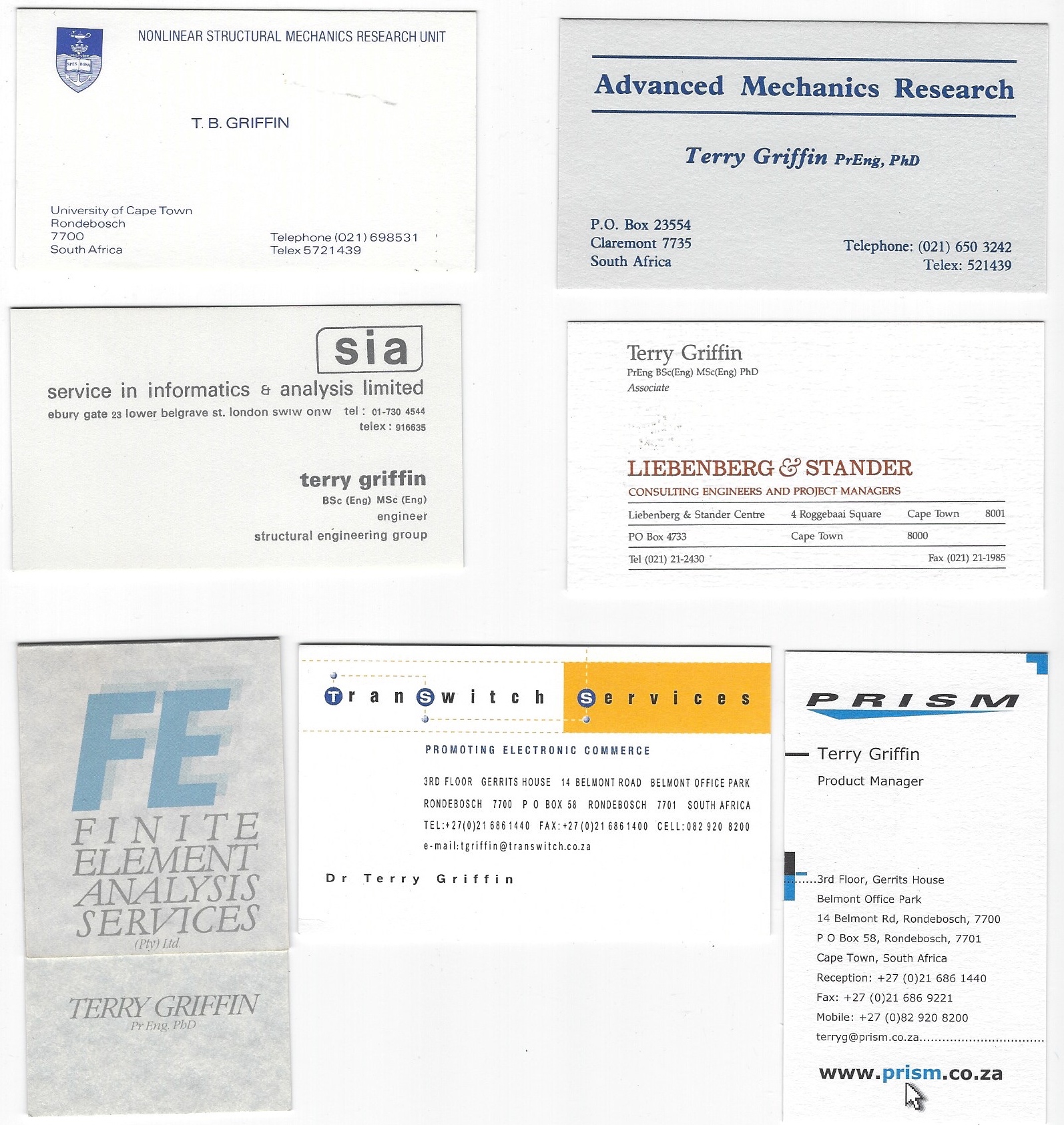
My very first proper job was a summer vac job at the end of Std 9 (Grade 11) working as a clerk for the Teal Record Company. My task was to process orders for the local record stores, putting the order together and creating the invoice. This was a fantastic job because Teal were the sole agents for most of the big record labels, including the Beatles. I was the first person in Cape Town to own a copy of the album A Hard Day's Night. I did the same thing after matric (just until Xmas!).
When I matriculated at the end of 1965 I had neither the means nor the academic laurels to go to university. So I got a job through a friend of my father's as a lowly clerk in the Sea Point branch of the United Building Society. Suitably attired in jacket and tie I arrived on the first Monday of February 1966 and began what I assumed was "work". I managed to endure it for three days and on the fourth I tendered my resignation. I can't remember what my poor father thought! As it happened, this set a precedent for my lifelong attitude towards formal work!
But Dad again came to the rescue and through another friend landed me a job with Marine Diamond Corporation. I was a learner plant operator on one of their diamond barges operating off the Namibian coast at Chameis Bay, somewhere between Luderitz and Alexander Bay (at the mouth of the Orange River). This was not a job for the faint-hearted, especially at the tender age of 17, and so I have described it in more detail here.
I saved enough money during my two years on the diamond barges to see my way through my first year at university (my university years are described here). So, armed with a masters degree in engineering I embarked on a career in structural engineering.
I should briefly digress here. I had my first exposure to computer programming in a third-year applied maths course at the University of Cape Town (UCT) in 1970. To say I was hooked is an understatement: I loved programming. So much so that I was given a key to the Applied Maths Building at UCT and access to the university's only computer, an IBM 1130. I used to go up there on a weekend night and write programs into the early hours, running the entire system on my own. The IBM had about as much power as a 1990's cellphone and could only do one job at a time. Still, it was fun and ground-breaking to play with. And thus my lifelong love of programming.
After graduating I worked for a large firm of consulting engineers for a year or so but decided that it was time to spread my wings a bit. So I took off for London where I duly presented myself at Service in Informatics and Analysis (SIA) in London and offered my services. On the basis of my recently aquired masters degree, I was hired.
SIA was a large computer bureau offering a wide variety of computational services, running one of the most powerful computer mainframes around: a CDC 6600 "supercomputer". Initially I did structural analysis projects using what was then the most sophisticated engineering software available, American software called NASTRAN. My clients included British Aerospace, Vickers Shipbuilding, British Leyland, and others, and I also did a number of NASTRAN workshops, including one for the European Space Agency, then based in Holland. A year later SIA decided to create their own structural analysis software and I was allocated a major component to develop. This new software was called Finite Element Modelling And Analysis Language For Engineers (FEMALE), and we later published it in an engineering software journal. I still have a copy of the user manual.
After three years in London a salesman and I were transfered to Holland to open a branch office in Rotterdam. It was a difficult call trying to sell to the Dutch (although a marvellous life!) and my partner and I didn't make much progress. Some eight months later I was offered a lectureship back at UCT and being somewhat tired of the European lifestyle and weather I decided to return home and once again enter academia.
After seven years teaching at UCT I left at the end of 1987 armed with a PhD in Engineering. UCT decided to commercialise the research unit I had been part of (Advanced Mechanics Research) and I offered to run it as an engineering consultancy. We called it Finite Element Analysis Services (FEAS) and although I was a one-man shop, I could call on an endless supply of post-grad students at UCT for assistance. We also had the RSA agency for an American engineering software package called ABAQUS, which we covertly (and illegally) supplied to Armscor and several other engineering firms.
However, I had bigger ideas and in 1990 I persuaded Liebenberg & Stander (L&S), one of the largest civil engineering firm in the country, to bring me onboard as their chief structural analyst. My main job was performing structural analyses for the briges and structures departments, but soon I was seconded to the Maritime Division to analyse components of a submarine that the government had commissioned and L&S were designing. We even had a mockup of the conning tower in the basement! Then early in 1993 the government stopped all the major military projects that were in progress and the entire Maritime Division was retrenched: no more submarines. I was placed on a three-day week (and lectured part-time at UCT to make up), but the work-flow for the firm was not good and at the end of September 1993 I resigned.
I had visions of becoming an independent software developer and had some ideas to work on. I met a guy with a similar vision and we developed a voice response system (which was regarded as cutting edge back then), which we called Televox. Indeed, we tried to sell it to the National Party to use in the 1994 elections, but it didn't fly.
To properly break into the IT world I got a job as a project manager at National Data Sytems (NDS), one of whose clients was Transwitch Services (TSS), Pick n Pay's EFT payment switch. Enthralled by what TSS was doing I moved there for a year and realised that EFT was where I wanted to be. And then an even better opportunity arose when Sanlam (of all places) created a new department called eBiz, which aimed to get into eCommerce, so off I went. It was there that I spotted the opportunity to create a credit card payment gateway. I secretly wrote a prototype gateway (based on what eBiz was trying unsuccesfully to do) and in August 1998 I took it straight to Transwitch, who had, of course, given me the basic know-how when I had briefy worked there. They declined the offer, but that wasn't the end of the story.
Towards the end of 1998 a company called BSW, to whom I was now contracted, persuaded Pick n Pay to sell TSS to Prism Holdings and to move some senior BSW managers (including me) in to help run the place. At the same time they renamed the company EasyPay, after the well know online payment system which Pick n Pay had owned. These were the wild west days of the dotcom boom and I had a great time developing my credit card payment system for EasyPay. The sytem remained in operation for nearly ten years and I still regard it as one of my best projects. Just for good measure I rewrote the EasyPay website using the new Cold Fusion development sofware.
These were great days, with so much new ground-breaking software being developed in the eCommerce domain. We expanded the EasyPay online system to include electricity purchases, TV licenses and gift vouchers and even offered our credit card payment facility to other websites. And best of all, because of the malleable management setup, we were earning terrific hourly contract fees. Alas, it wasn't to last. A few years later Prism tightened its grasp on EasyPay and terminated all contract workers. They offered me a permanent position but I was so used to being my own boss (working significantly from home) that I demurred.
Leaving EasyPay was probably not a great decision but it forced me to explore other fields. I turned to the mobile phone world which in 2004 was still wide open: smart phones weren't yet common and Android hadn't yet made an appearance. I wrote a mobile app for EasyPay but it wasn't really useful given the dire state of mobile phone development tools and the broad spectrum of phones all using different operating systems.
In 2005 I started dabbling in the stock market. Soon I was a de facto day trader and turning decent profits. Moreover, I loved trading, and it provided a good life. Alas, I was too inexperienced to deal with the 2008 market crash and although I soldiered bravely on I decided to cut my losses in mid-2011.
In September 2012 I joined an ex-colleague from EasyPay in a web develoment company in Hermanus. Here I continued developing my online event entry system called ntri aimed primarily at the openwater swimming fraternity (in which I was a keen participant). I serviced all the local open water swimming events including the well-known Freedom Swim, as well as events organised by the Cape Long Distance Swimming Association (CLDSA). This was largely a labour of love and barely broke even. In October 2015 the Freedom Swim people, my primary clients, pulled the plug and that was the end of ntri.
Ever since my time at EasyPay I had kept in touch with some of my ex-colleagues. In November 2014 one such colleague invited me to join him on a fact-finding business trip to Kenya on behalf of a local IT company. I went back again in April 2015, but business was exceptionally hard to do there and after nearly a year of battling along I gave up. In Kenya I was nearly locked up by the law twice: once for "spying" (I took a photo of the UN Embassy compound and had to pay a bribe to be released) and once for smoking in a no-smoking zone at the airport. I won't be going back again!