The Songwriter
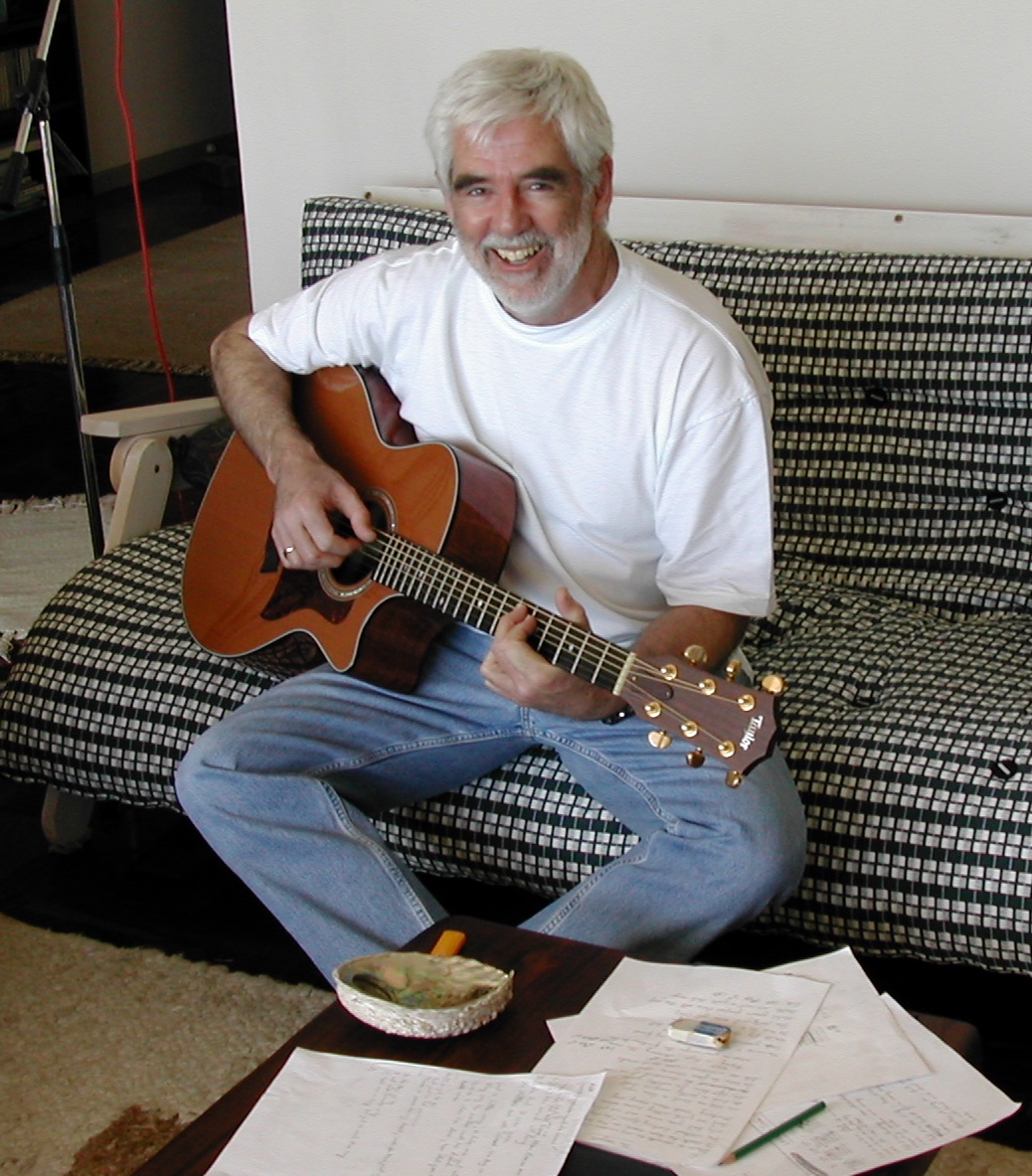
I started playing guitar when I was about thirteen, around 1962, and have never been without one since. Initially, my interest was in playing in a band and leading rousing sing-songs with my brothers and friends, which I did for a number of years. But my university studies put a damper on these activities and it wasn't until I graduated in 1974 that I had the time and enthusiasm to devote to my music, this time in the form of songwriting. As often happens, my first attempts were inspired by love (or lack thereof!), in this case in the form of an English lady named Sue who had captured my heart - and then left. I continued to write songs, including one or two about the June 1976 Soweto uprising.
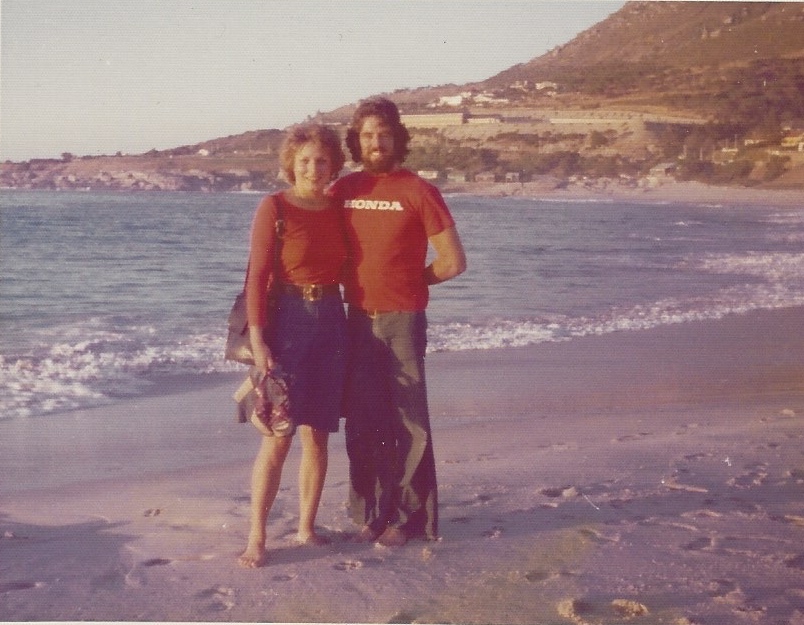
Sue: Inspiration for the Things To Remind Me
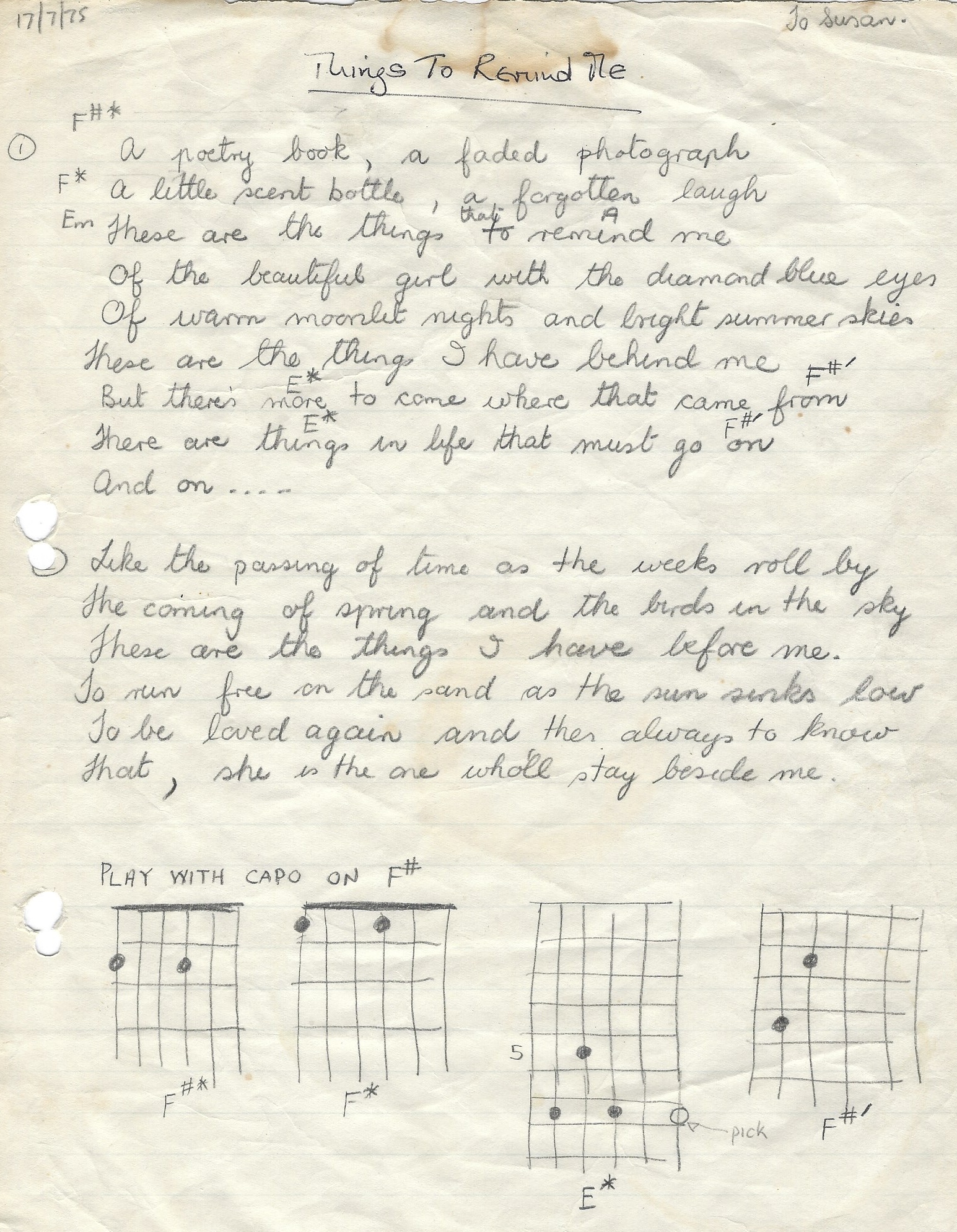
Things To Remind Me (1975)
In July 1976 I left for the UK to work. Some eighteen months later a friend, Judie, from back home came to visit me over Xmas 1977, so I wrote her a song. Then Anne came along and I wrote a few for her as well. Of course, this was many years before home recording was possible so none of these songs were ever recorded, although I did sing them so the respective inspirations, and even their mother in one case. As my time in the UK and Holland drew to a close I made a few more desultory stabs at writing, but it would be many years before inspiration struck again. I'm still not sure what happened during the eighties and nineties, but not a single new song was forthcoming, although I still played my guitar and sang covers to amuse myself.
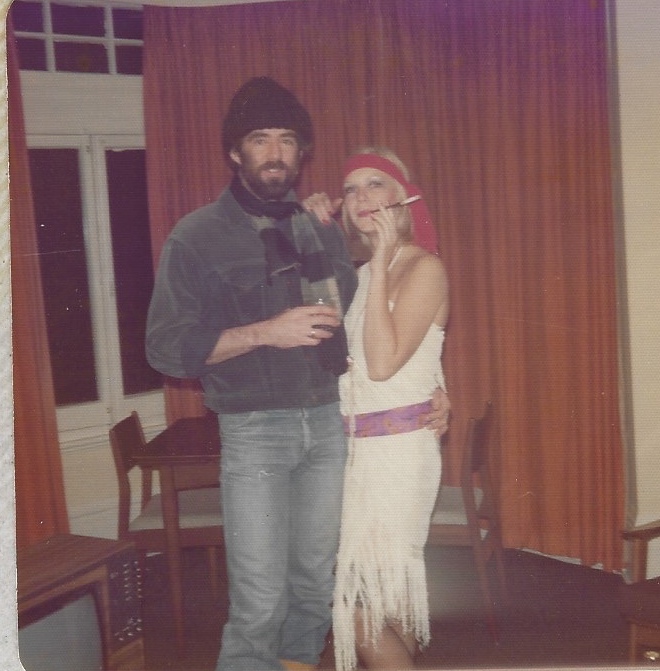
Judie: Inspiration for the Where I'm Flying

Where I'm Flying (1977)
When I look back on my progression towards becoming a songwriter I notice a number of contributing factors:
- A love of playing my guitar, combined with an interest in exploring the sounds or melodies that it can make, especially via chord structures.
- A good teacher: when Shane invited me to join his band in 1965 he taught me not only the band's repertoire of songs but also how to play the chords correctly. Later on, Alvin Dyers at The Jazz Workshop would play an even more important role, introducing me to most of the jazz classics.
- Playing to an audience. When my band days were left behind in the late sixties, I started playing sing-songs in which the crowd heartily joined in. This was both easy and enjoyable in the days of Beatles and Stones, but forced me to "know my stuff" and play all the popular songs properly.
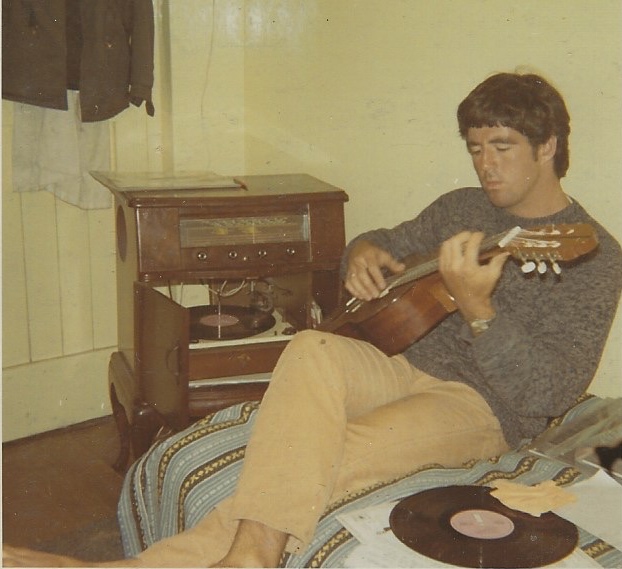
Working out a new song, 1973. How's the modern gramophone?
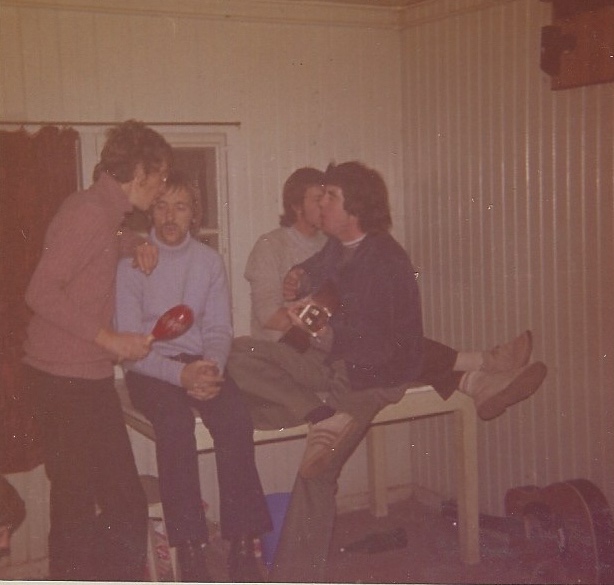
A typical sing-song, four-part harmony with maraccas
Even more important was my knowledge of current pop music. I would buy or borrow an album (LP), write down the lyrics and work out the chords to all the songs that interested me (remember, this was before Google and the Internet!). By doing this I learned endless song and chord structures, which not only formed a basis for my sing-songs but also for my knowledge of how a good pop song was put together. It was like a pop music apprenticeship, studying the masters. Later, Alvin Dyers did the same for me in the jazz domain: study the classics!
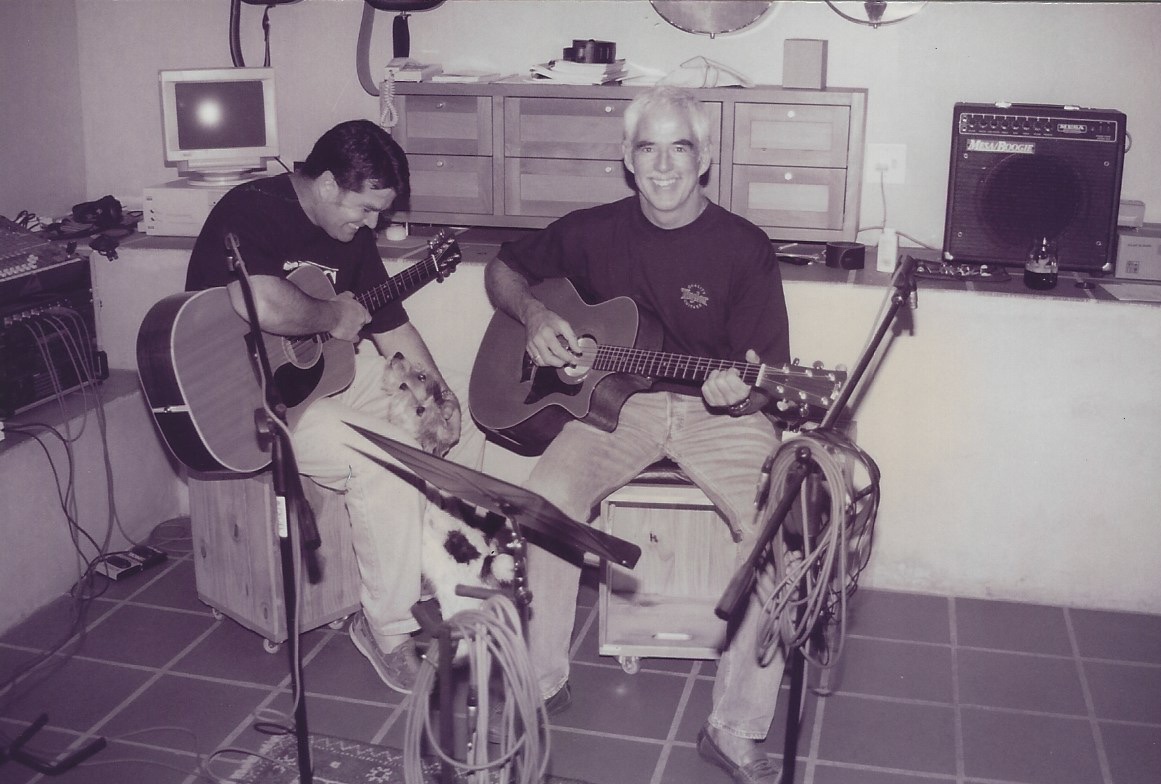
[Alas, I have no personal pictures of Alvin]
Sometime in 1998 I bumped into an ex-student of mine, Dan Ahern. We started jamming together, and eventually recorded an album of cover songs. I have Dan to thank for introducing me to Alvin Dyers at the Jazz Workshop in 1999. Here I attended weekly lessons for almost six years, learning many jazz classics and hundreds of new (jazz) chords. It was largely thanks to this exposure that I began to write songs again. Alvin was a marvellous teacher and my new and expanding repertoire of chords allowed me to experiment with new song structures, often following the jazz classics, and introduce new melodies.
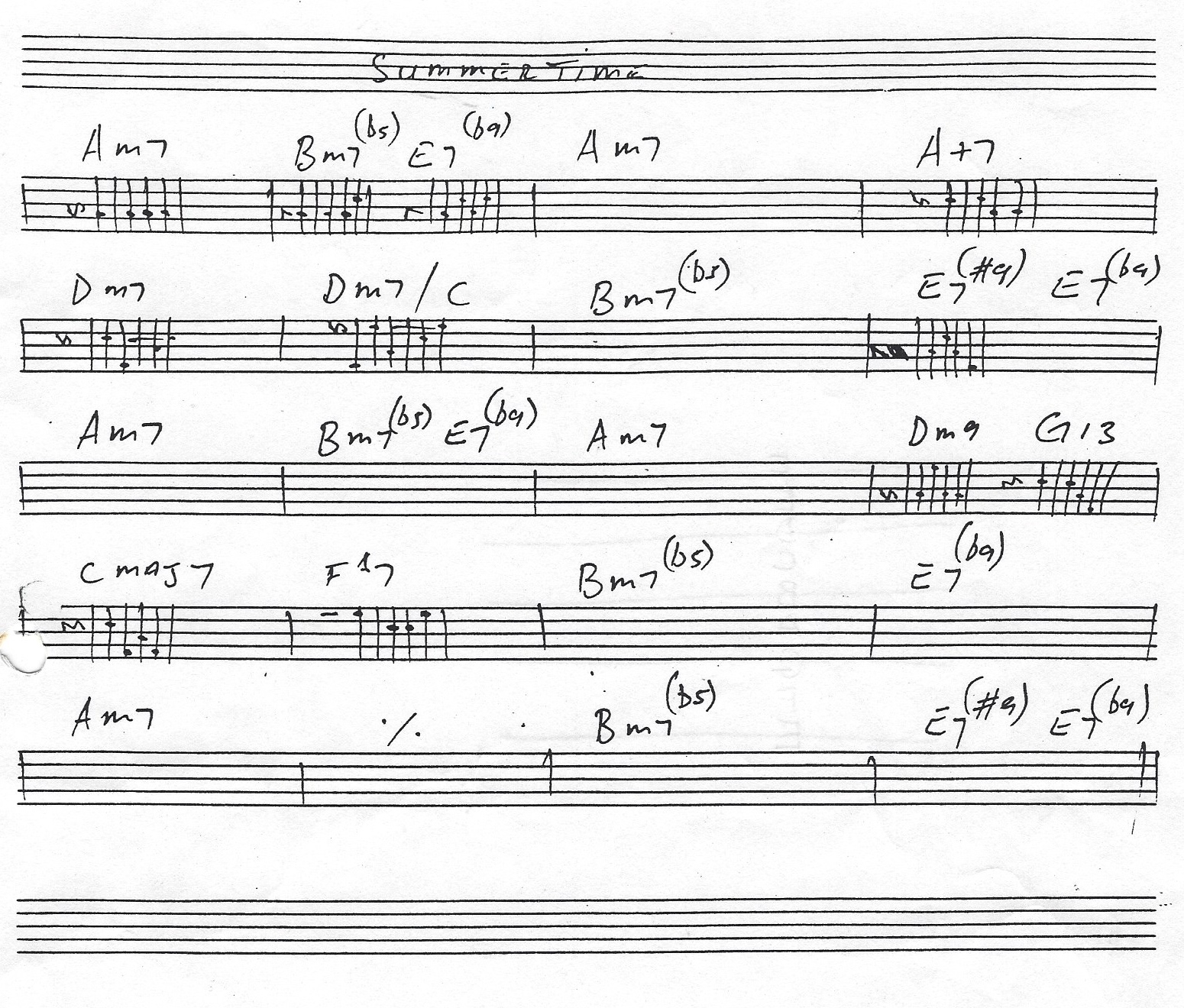
Alvin's score of Summertime

Alvin's score of The Shadow Of Your Smile
Alvin's scores were hand-written during each lesson so that I had something to take home and practice on. Every new song introduced me to new and wondrous chords, which I then tried to use in my own songs (see below). Gradually we spent more time on my new songs than on the classics. Thus my lessons transformed into critiques of my latest song, in which Alvin in his infinite patience offered guidance and advice. I'll never forget Alvin saying to me one day: "Terry, I think we have a winner here!", probably facetiously. Thanks, Alvin!

My score for Bali Bay (2003)
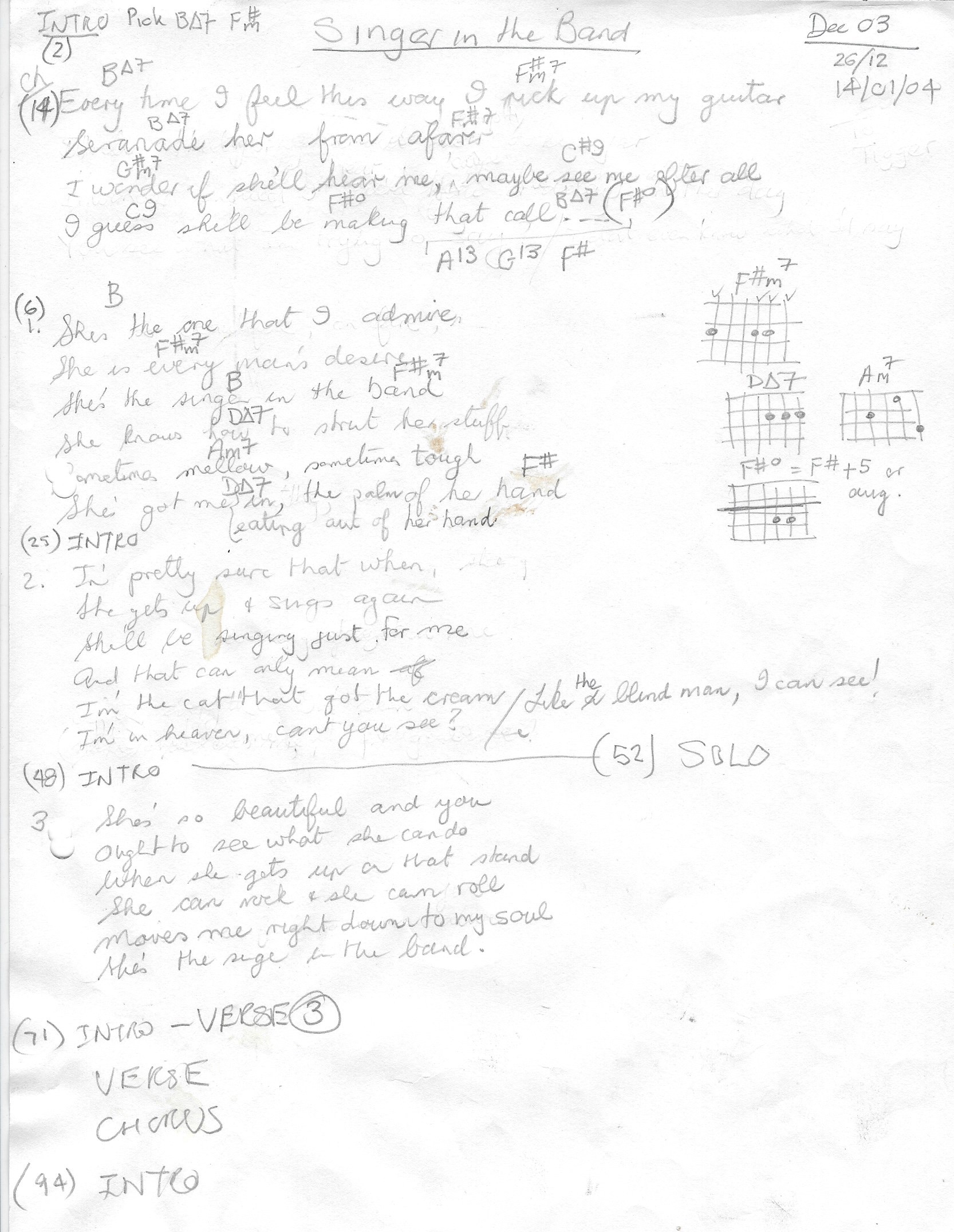
My score for Singer In The Band (2004)

The score for Winner #2 which became The Stiff (2001)
By 2001 I was now writing quite prolifically (under Alvin's tutorage) and wanted to record. But Dan had no interest in recording my songs and as a result in mid-2002 I bought my own analog recording system, a Roland VS880EX. Why did I go the analog recording route? Because digital recording required a quality PC and recording software, both of which were still very expensive.

Around the same time I had become friendly with Beverly Rinkwest, an aspiring jazz singer and song-writer, who was giving singing lessons at the Jazz Workshop. We decided to enter the Old Mutual Jazz Competition with Beverly singing two of my songs, accompanied by me. We reached the regional finals! Thus encouraged, I recorded my first album Shooting The Breeze with Beverly singing on the title track. But the Roland VS880EX was an extremely clunky way of recording and I only produced that one album on it. However, the act of recording introduced a new level of discipline into my songwriting, and provided a way to critically review what I was writing, often with disappointing results, but always learning.
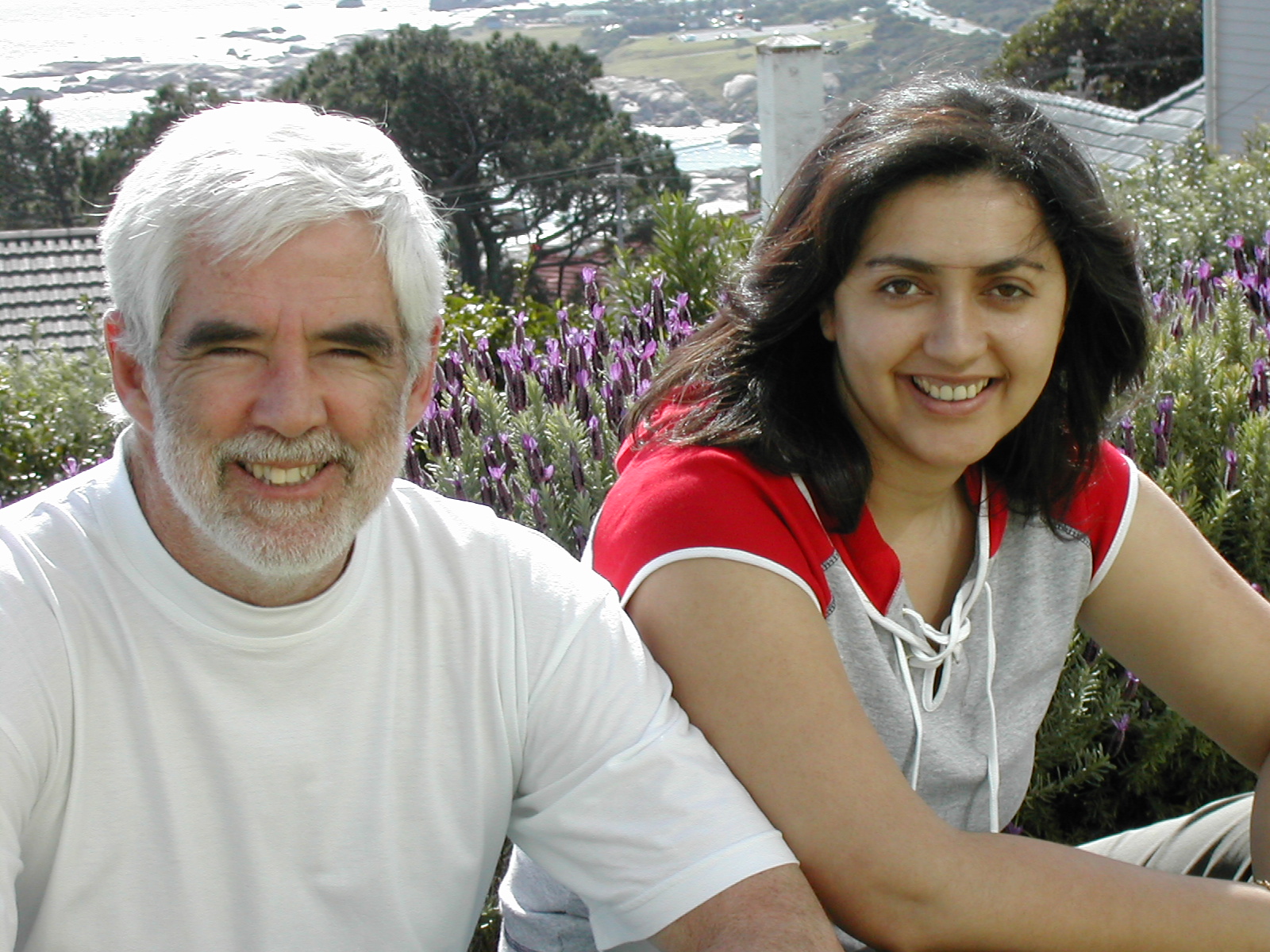
Beverly and I during Shooting The Breeze
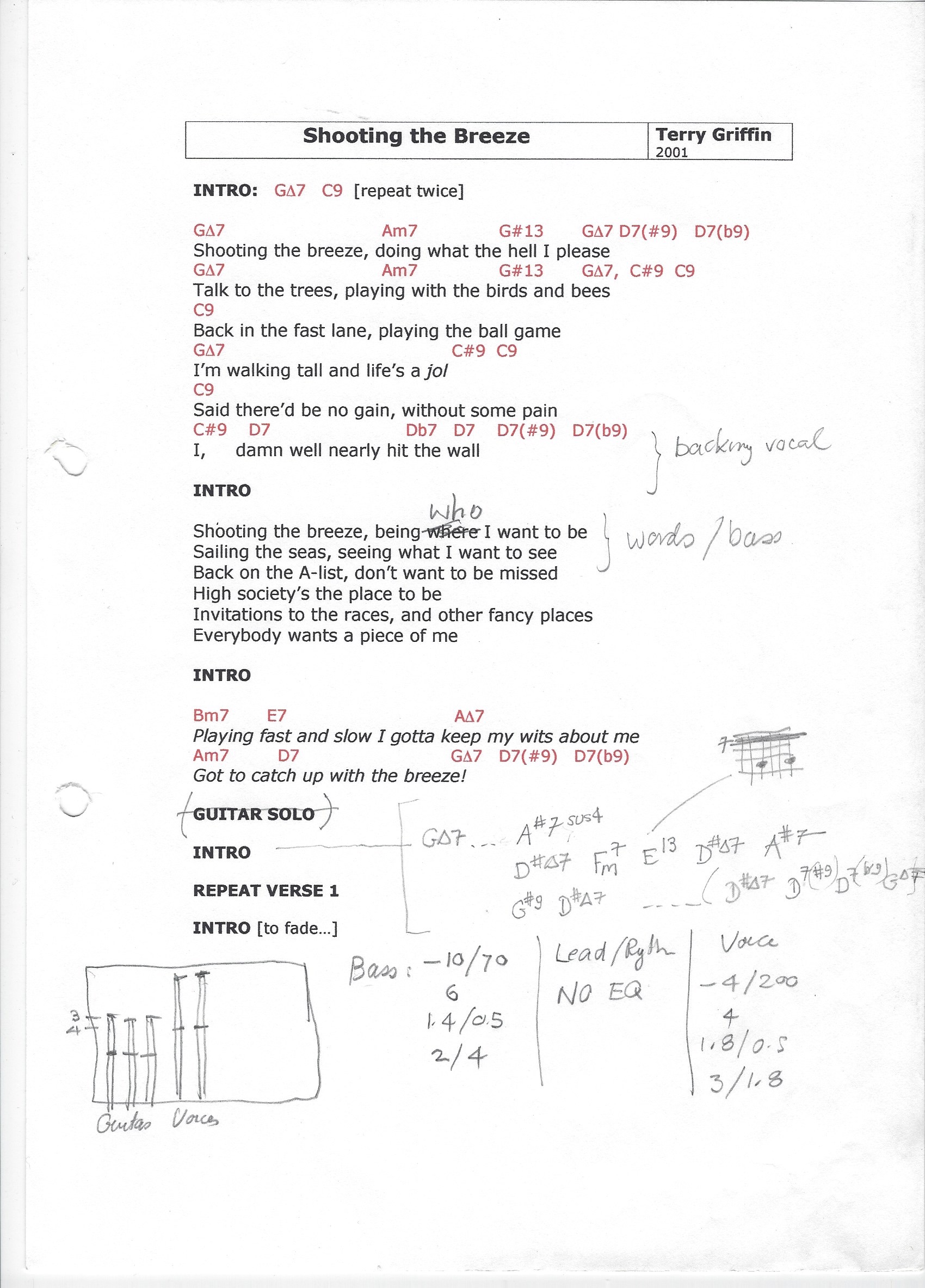
My score for Shooting The Breeze
The album Shooting The Breeze although poorly recorded (and played, for that matter!) contained what I still think of as some of my best songs: Friday Night, Love Is A Dream, The Stiff, and Seagull, all of which I have subsequently rerecorded on later albums. So in April 2003, I decided to go to the New Orleans Jazz Festival, travel the so-called Blues Route (New Orleans - Memphis - Nashvile) and plug my album. While in Nashville I visited the American Society of Composers, Authors and Publishers (ASCAP) and fortuitously wangled a meeting with one of the vice-presidents, who, learning I was from South Africa and about to board a plane home, listened to my Shooting The Breeze album. He said the songs had merit, but his advice was to have the album recorded by professional musicians. I returned home eager to do just that.

I suggested to Beverly that we pool our best songs and have them recorded by professional musicians. In early 2004 I engaged a friend of mine, Tigger Reunert, who was keen to set up a recording studio, to record our songs, but his recording studio turned out to be whatever bedroom he was currently living in and Beverly and I were not overly happy with the result. So we took what we could salvage from the bedroom sessions, engaged Beverly's excellent band, and reworked the album in a proper recording studio. The result was Silent Moments.
In January 2005 Beverly and her band played a lunchtime gig at the Standard Bank Jazzathon at the V&A Waterfront, including most of Silent Moments. Seeing and hearing my songs played in public was such a thrill for me, espcially since I had invited my mother along as well. I presented copies of the album to all the local radio stations and it did get a fair bit of airtime, particularly from Fine Music Radio. Having registered with the South African Music Rights Organisation (SAMRO) I even received modest royalties.
Beverly and I were somewhat disappointed that Silent Moments didn't sell as well as we'd hoped, largely due to a lack of marketing. In January 2005 I finally ended my jazz lessons with Alvin, after six years, and possibly as a result the year 2005 dragged by with no new songs. I finally realised that it was also time to move from the clunky VS880EX to the digital domain, and I set myself up with a brand new computer and the latest Cubase recording software. In April 2006 I started recording on Cubase.
Recording on Cubase spurred me to create a proper home recording studio and to invest in more recording gear, including a keyboard. I had seven guitars: two electric, two acoustic, two basses, and a Spanish nylon string. I played all the instruments, which included piano, flute, saxophone, strings and various others on the keyboard synthesiser, and although I had absolutely no piano training, the keyboard became my most fun instrument.
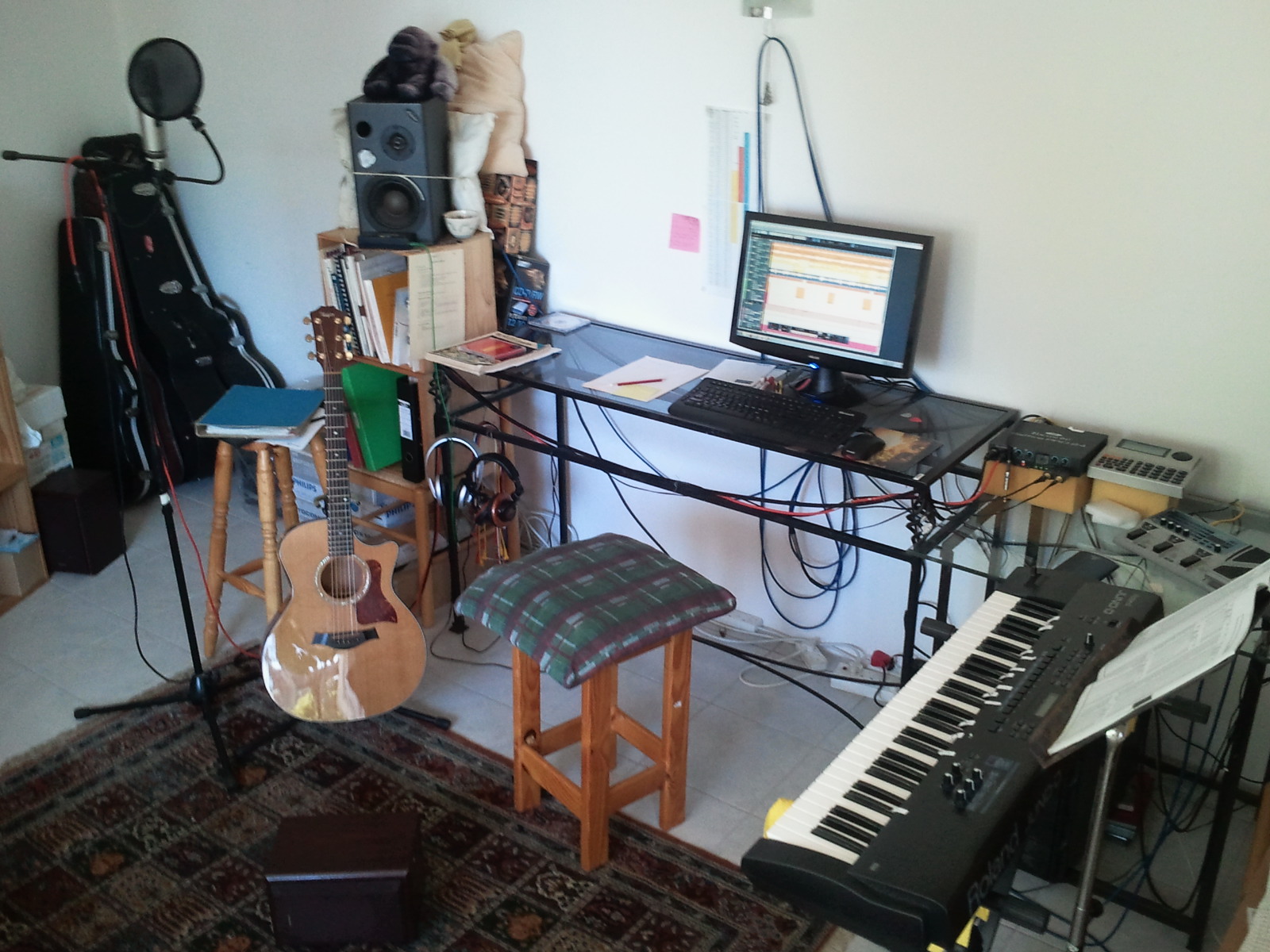
Studio in Camps Bay (2005-2012)

Current studio in Somerset West (2015-present)
For writing songs I rely entirely on my Taylor acoustic guitar. Every day I practice my favourite songs for a while and then digress into playing around with chords and melodies, writing them all down for future reference (see sidebar). I always write the music first, and then let the style or tone of the music suggest a lyric. Needless to say, a broken heart always used to be a good start (although thankfully those days are behind me!), and I do have a penchant for trying to be amusing or facetious.

Chord doodles for new songs
I have chosen a selection of songs from the past ten years or so that illustrate my lyric styles. Broadly speaking, they can be divided into Love, Personal, and Comic, each of which has a sub-category of facetiousness.
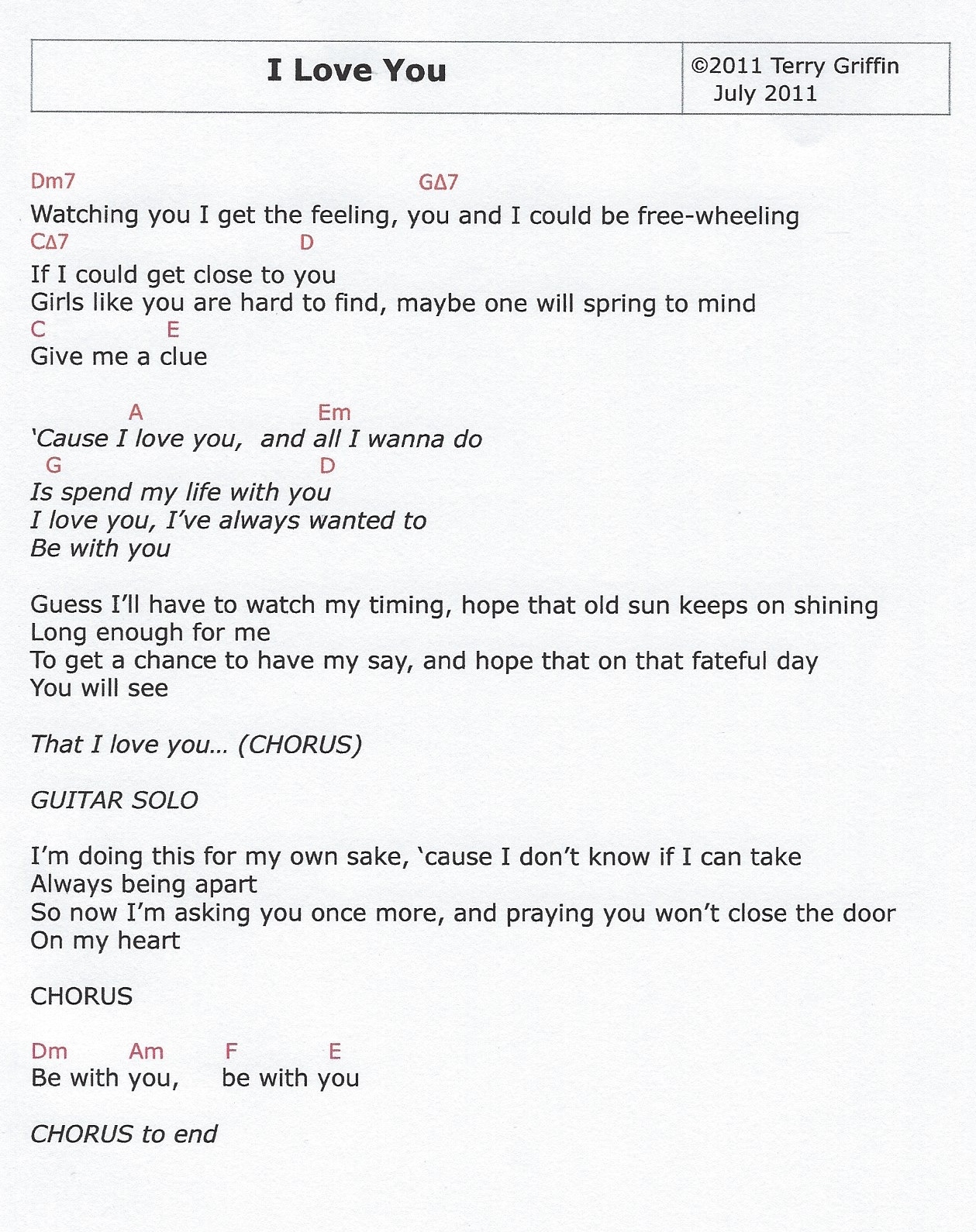
I Love You is probably my best love song although, funny enough, it was not written with anyone particular in mind. Others include She's A Lady, For You And Me, and Come A Long Way. There are also fun love songs like What More Can I Do?
My favorite is Medical Practitioner which I wrote after my awful bicycle accident and spending a lot of time in hospital. I sent copies to all the doctors who had attended me during the ordeal as a tongue-in-cheek way of saying thank you. Oliver & Wendell and Henri & Louis are classic fun songs, one about the wild west and the other about the Tour de France. Before It's Too Late is a joke about getting old. Evolution, on the other hand, is a tongue-in-cheek look at evolution.
Home On The Hill is my favourite and together with Garden Of Dreams recounts my very happy days in Tree Rd, Camps Bay. Cross That Line and Freedom Mean Alone are the more pathos-laden numbers.